How to Choose the Best US Vehicle Recall Data API (2026 Guide)
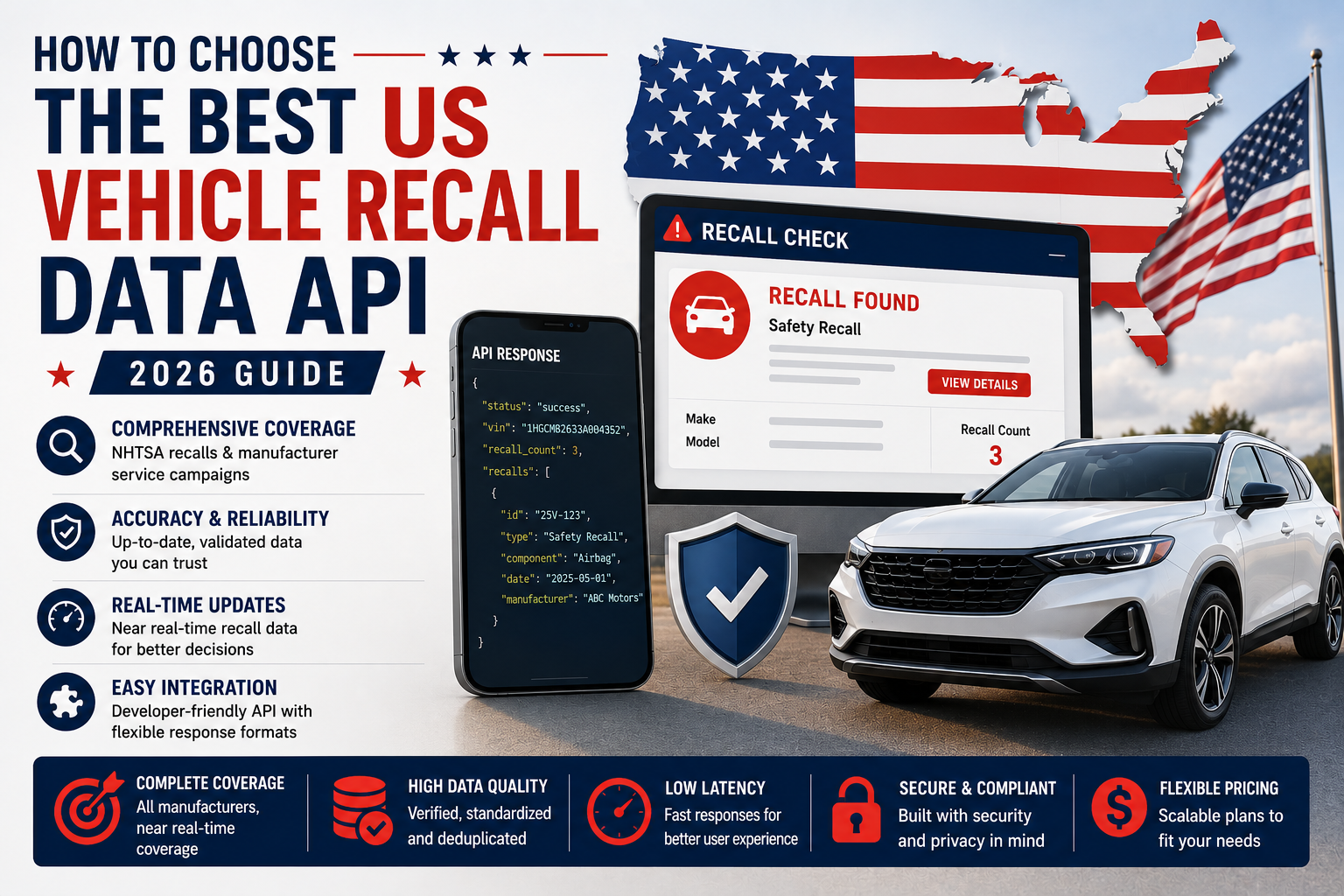
When integrating vehicle recall data into an automotive platform, dealer management system, fleet solution, vehicle history report or consumer website, choosing the right data provider can have a significant impact on user experience, operational efficiency and commercial value.
For many organisations, the obvious starting point is the free NHTSA Recall API. It provides an excellent public resource for accessing US vehicle safety recall information and is widely used for manual lookups.
However, as businesses grow and vehicle recall checks become embedded into customer journeys or high-volume workflows, many discover that integration with a commercial recall data provider offers substantial benefits.
This guide explains the differences between the two approaches and what to look for when selecting a commercial US recall API.
The Free NHTSA Recall API
The National Highway Traffic Safety Administration (NHTSA) publishes recall information free of charge through its public APIs and website.
The service allows users to:
- Manually search recalls by VIN through the NHTSA website.
- Retrieve recall information by make, model and model year through the API.
For many users this is an excellent starting point, particularly for proof-of-concept development or use cases where occasional manual lookups are sufficient.
However, the public API has clear limitations for commercial software providers who need VIN level recall verification as an integral part of the user experience, or to perform checks at scale.
Most notably, while the website supports VIN searches, businesses looking to automate VIN-based recall lookups via API need a commercial data provider.
Why Commercial Recall APIs Exist
In most real-world automotive applications, users don’t know a vehicles’ make, model and year (as defined by NHTSA) – and in any case, this won’t answer the question about whether a specific vehicle has outstanding recalls.
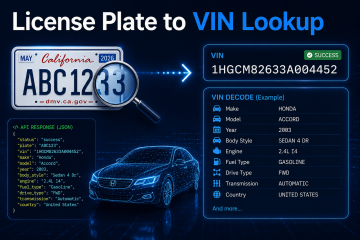
Commercial providers bridge the gap by offering VIN-based recall APIs, making it possible to automate recall checks without requiring users to manually identify the vehicle.
This enables recall data to be integrated into:
- Vehicle history reports
- Dealer stock management systems
- Trade-in valuation tools
- Fleet management platforms
- Workshop software
- Consumer vehicle check websites
- Insurance and finance platforms
- Data cleansing and compliance projects
Many providers also support high-volume batch processing, allowing millions of vehicles to be checked automatically.
What to Look For in a Commercial Recall Provider
Not all recall data providers are equal.
The cheapest provider isn’t always the lowest cost in practice, and the most expensive isn’t necessarily the best.
When comparing providers, there are three key areas to evaluate.
1. Cost
Pricing remains one of the biggest differentiators.
Things to consider include:
- Cost per lookup
- Minimum monthly commitments
- Enterprise discounts
- Batch pricing
- Volume pricing
- Hidden platform fees
For startups, high minimum commitments are a barrier to entry.
Conversely, enterprises processing millions of VINs each month need pricing that scales – and predictable volumes enable minimum volume commitments.
The best providers are capable of offering competitive pricing across both ends of the spectrum, enabling start-ups to choose a provider and scale as they grow.
2. Flexibility
Vehicle volumes are often difficult to predict.
A startup may process only hundreds of vehicles in its first month before rapidly scaling (up or down). Likewise, enterprise workloads can fluctuate significantly due to customer onboarding, fleet migrations or seasonal demand.
Look for providers that offer:
- Low initial costs
- No excessive minimum commitments
- Pay-as-you-grow pricing
- Easy migration to enterprise pricing
This allows businesses to launch quickly without committing to volumes they may never reach – without paying over the odds when volume arrives unannounced.
3. Technical Capability
The technical differences between providers are often more significant than the commercial ones.
Fast Recall Updates
Speed matters.
Some commercial providers publish new recalls extremely quickly—sometimes before they appear within NHTSA’s publicly available datasets.
For manufacturers, dealers, fleet operators and vehicle history providers, this earlier visibility can provide a valuable operational advantage.
When evaluating providers, ask:
- How frequently is recall data updated?
- How quickly are new recalls made available?
- Is data refreshed continuously or on scheduled batches?
Small differences are important where vehicle safety and competitive advantage is concerned – making near real-time coverage the goal.
Manufacturer Service Campaigns
One of the biggest differentiators is whether the provider includes manufacturer service campaigns alongside official safety recalls.
These programmes often include:
- Customer satisfaction campaigns
- Service actions
- Technical service campaigns
- Product improvements
- Voluntary manufacturer campaigns
Although these are not legally classified as safety recalls, they can represent valuable work for franchised dealers.
For dealer groups, this can create additional workshop revenue while also identifying vehicles requiring manufacturer-funded work.
When valuing trade-ins or purchasing used stock, this information can influence buying decisions and trade-in valuations to provide an extra competitive edge.
Low Latency
Performance is frequently overlooked until systems reach production.
Low latency is essential for two very different reasons.
Consumer applications
Customers expect vehicle checks to complete almost instantly.
Slow APIs increase abandonment rates and reduce user satisfaction.
Enterprise processing
Fleet operators, remarketing businesses and data providers may process hundreds of thousands—or even millions—of VINs.
Even small improvements in API response times can translate into hours of saved processing time across large datasets – and for organisations performing bulk vehicle cleansing, latency can have a direct operational impact.
Real-World Performance Varies More Than You Might Expect
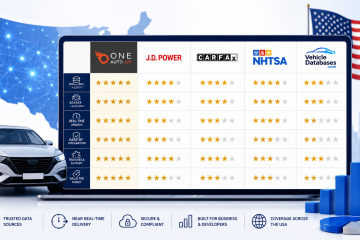
During April 2026, One Auto API conducted a side-by-side technical evaluation of three leading US vehicle recall providers before selecting the technology behind our US Recall API.
The assessment compared providers across multiple criteria including:
- Update frequency
- Data coverage
- Availability of manufacturer programmes
- API performance
- Latency
The differences were significant.
Rather than marginal improvements, we observed substantial variation across every category – ultimately selecting a partner that delivers strong performance in all the key areas.
For our customers, this means they benefit from a rigorous technical evaluation – resulting in a high service level, at a competitive price.
Which Solution Is Right for You?
The NHTSA API remains an excellent free resource and should be considered by developers looking to experiment with recall data or perform occasional manual research.
However, organisations building production systems typically benefit from a commercial provider that offers:
- VIN-based API lookups
- High-volume batch processing
- Faster data updates
- Manufacturer service programmes
- Low latency
- Flexible commercial model
These features enable recall checking to become a seamless part of customer journeys, dealer workflows and enterprise-scale automotive platforms.
Access US Recall Data Through One Auto API
One Auto API provides a high-performance US Vehicle Recall API designed for developers, dealers, fleets, insurers and automotive software providers.
The service delivers fast VIN-based recall lookups through a simple REST API, making it easy to integrate recall checks into websites, mobile apps, dealer systems, fleet platforms and vehicle history reports.
Whether you’re launching a startup or processing millions of vehicles each month, our flexible commercial model allows you to start small and scale as your business grows.
Learn more: https://www.oneautoapi.com/service/recall-report-vin-us/