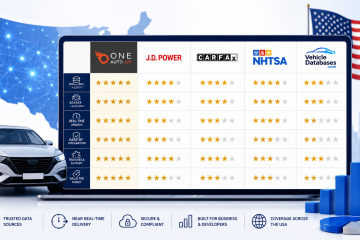
Top VIN Decoder API Options for the USA: Which Provider Is Right for Your Business?

A VIN Decoder API is often the first vehicle data service a startup, marketplace, insurance platform, finance provider or AI agent needs to integrate.
At a basic level, a VIN decoder converts a 17-character vehicle identification number into structured data such as make, model, model year, body style, engine type and manufacturing information.
But not all VIN decode services are equal.
Some are free but limited. Some are low cost with limited data and restrictions on daily usage. Others provide rich build data, installed options and invoice pricing, but only on enterprise pricing deals.
For startups and scaleups, the challenge is finding a provider that is simple enough to start with, detailed enough to use in production, and scalable enough to support growth.
Below is a practical comparison of 7 of main VIN decoder options available for the US market.
1. NHTSA vPIC VIN Decoder
Best for: Free lookups, prototypes and safety-focused applications
The NHTSA vPIC VIN Decoder API is an obvious starting point for many developers because it is free and based on data submitted by vehicle manufacturers.
It returns around 80 to 140 attributes, depending on the vehicle and the data available. This includes make, model, model year, manufacturer, body type, engine details, fuel type, plant information and data on safety related features.
Strengths
NHTSA is free, official and widely used. For early-stage testing, internal tools or basic proof-of-concept work, it can be a useful way to validate an idea without committing to a commercial provider.
Because the data is submitted by vehicle manufacturers, it also carries a strong level of authority for safety and compliance-focused data.
Weaknesses
NHTSA is not designed as a commercial-grade automotive data product. It is subject to shared rate limits, and the output may require additional mapping to other datasets before it is suitable for production customer-facing applications.
It doesn’t provide full commercial build data, installed factory options, invoice pricing or broader vehicle intelligence.
Verdict: Excellent for free basic decoding, but most commercial users will eventually need something richer and more scalable.
2. CarAPI
Best for: Low-cost entry-level VIN decoder API
CarAPI is a low-cost option with annual subscriptions typically in the $200–300 range. It appears to build on NHTSA data and can be suitable for developers looking for a simple, affordable way to decode VINs.
Strengths
CarAPI is inexpensive and easy to understand commercially. For small applications with predictable volumes, it can be a practical entry-level option.
Weaknesses
Plans include hard daily request limits, ranging from 1,500 to 6,000 requests per day.
For a small app this may be fine, but for platforms who expect to eventually process vehicle data at scale, hard daily caps may be too restrictive.
The output provides trim options rather than true trim identification or installed options
Verdict: A good low-cost option for small projects who want to have fixed costs, but less suitable for projects that need richer levels of vehicle data or requirements for scale.
3. DataOne Software VIN Decoder API
Best for: Established automotive businesses needing rich US vehicle data
DataOne Software is one of the more established commercial VIN decoding providers in the US market. Founded in 1999, it has significant experience and reputation in automotive data.
Its more advanced VIN decode products include standard specifications and installed options data, making it suitable for more demanding use cases across automotive retail, finance, insurance and remarketing.
Strengths
DataOne has depth, experience and credibility. For businesses that need a mature automotive data supplier, it is a serious option.
Advanced options provide much richer data output than basic VIN decoders, including standard specs and installed equipment.
Weaknesses
Pricing is not published and is determined by volume, use case and commercial terms. Minimum term and spend commitments are likely to apply, which may make it less suitable for early-stage startups.
Integration and procurement may be more involved.
Verdict: Strong enterprise-grade option, but potentially requiring more commercial commitment than many startups will be willing to entertain.
4. Vincario VIN Decoder
Best for: Simple volume-based monthly subscription.
Vincario offers a VIN decoder with pricing that starts at $49/mo for 100 lookups (49c each), reducing to 22c each for a package of 5,000 lookups at $1,099/mo – with bespoke pricing available above that level.
Strengths
Pricing is relatively transparent with different levels of monthly commitment.
Weaknesses
Relatively basic level of data, with high costs per-lookup compared to other providers.
Verdict: Easy to get started, but costs are unlikely to be sufficiently competitive for scale-ups.
5. auto.dev
Best for: Basic Make, Model, Trim & Year VIN Decoder.
auto.dev offers low-cost VIN decoding, including a free tier. Its core VIN decode output is relatively basic, focused around make, model, trim and year.
Additional data covering specification and build is available, but only on higher-tier plans with fees of $299 or $599 per month.
Strengths
auto.dev is attractive for developers looking for a simple API with a low-cost starting point.
The free tier also makes it easy to test.
Weaknesses
The basic VIN decode is limited. More valuable specification and build data requires higher monthly plans, which may be uneconomic for businesses with lower or unpredictable volumes. This creates a difficult gap for startups: the free or low-cost product may not be rich enough, and the higher-tier plans may be too expensive.
Verdict: Good for very basic decoding, but advanced data requires a step-up that may be too early for startups.
6. VehicleDatabases.com
Best for: Simple paid VIN lookup volumes
VehicleDatabases.com offers VIN Decoder packages starting at $100/mo for 500 lookups, equivalent to around $0.20 per lookup. Pricing reduces to 5c per lookup at 50,000 lookups per month ($2,500).
Strengths
The pricing ladder is straightforward, and the higher-volume unit pricing is competitive.
Weaknesses
The main limitation is scalability. Rate limits start at 1 call per second, and increase to a maximum of 5 calls per second on the $2,500/mo Enterprise package – which may be too restrictive for higher-volume platforms, batch processing or enterprise applications.
Verdict: Reasonable for controlled lookup volumes, but rate limits prevent true enterprise-scale use.
7. One Auto API
Best for: Best all round for startups, scaleups and enterprise applications.
One Auto API is designed for businesses that need flexibility with the ability to scale.
The basic US VIN Decoder returns 22 fixed fields designed to identify trim level and model year clearly and consistently, with pricing starting at 25c per lookup on a PrePay plan with no monthly fee or minimum commitment – reducing to 8c on their Enterprise plan.
VIN Decode Plus option adds standard specification, installed options and invoice pricing, with pricing from $0.15 per lookup.
Strengths
One Auto API offers a strong balance between affordability, flexibility and scalability.
The PrePay option makes it easy to build and launch a product with high quality data and no monthly subscription overheads. For scale-ups, the transition to a monthly plan is seamless and provides lower unit costs and the ability to scale.
VIN decoding is only one part of the platform. One subscription provides access to a vast range of vehicle data services, including low-cost license plate, lookups vehicle images, valuations, recalls, service history, build sheet data and more.
Weaknesses
Developers who need free, safety-focused VIN Decoder responses, may find NHTSA to be sufficient for their initial requirements.
Enterprise customers with established, predictable volume may also consider established suppliers such as DataOne who can match One Auto API for scalability.
However, for most startups, scaleups and enterprises, the balance of price, scalability, flexibility and data coverage makes One Auto API an attractive choice.
Verdict: The best overall option for startups and scaleups that want a simple way to start, with competitive pricing and high quality data, with access to a broader vehicle data ecosystem.
Comparison Table
| Provider | Pricing | Strengths | Limitations |
| NHTSA | Free | Official vehicle manufacturer submitted data; 80–140 attributes; good for safety-focused use cases | Fair use limits; 300–600ms latency; not full specification or build data |
| CarAPI | $200–300 annual subscription | Low-cost entry point; simple API | Hard daily limits; trim options rather than true build identification |
| DataOne Software | Commercial, volume/use-case based | Strong reputation; advanced specs and installed options | No published pricing; minimum contractual commitments |
| Vincario | $49/mo for 100 lookups, reducing to around 22c per lookup for 5,000 ($1,099/mo) | Transparent monthly pricing | Expensive at low-medium volumes. |
| auto.dev | Free tier; with advanced plans for $299–599/mo | Basic MMTY decoding; easy to test | Specs/build data only available on higher plans; may be uneconomic at lower volume |
| VehicleDatabases.com | From $100/mo for 500 lookups | Straightforward pricing; lower unit costs as volume increases | Low rate limits of 1–5 calls per second |
| One Auto API | 25c PrePay option with no monthly minimum – falling to 8c on monthly plans | Flexible, scalable pricing and technology | Not free; users needing only basic safety data may prefer NHTSA |
Which VIN Decoder API Should You Choose?
The best VIN decoder depends on what you are building.
If you need a free lookup, NHTSA is hard to beat – but may not offer the depth of data needed for production applications.
If you want a low-cost developer tool, CarAPI or auto.dev may be worth testing.
If you need an established enterprise grade provider with deep build information, DataOne Software is a strong candidate, but without the breadth of data provided by other platforms.
One Auto API aims to give startups a better path: starting with competitively priced PrePay credits and no monthly commitment, transitioning seamlessly to monthly plans with lower unit costs as volumes increase.
For businesses that need to move quickly, One Auto API offers instant access to the widest range of data with the assurance of future scalability – making it an obvious choice for start-ups, scale-ups and larger enterprises.